Workspace-Bench 1.0
Workspace-Bench evaluates how well AI agents operate in realistic workspaces with large-scale file dependencies. It measures whether agents can discover relevant files, reason across implicit context, modify artifacts safely, and deliver the right output under rubric-based evaluation.
Workspace-Bench highlights
Independent benchmark summaries for workspace agents, model backbones, and benchmark composition.
Human reference remains ahead
Workspace-Bench reports a clear gap between human performance and current evaluated agents.
Latest benchmark updates
Major milestones and feature additions since the benchmark's public launch.
Benchmark release
Workspace-Bench and Workspace-Bench-Lite were released together with the public repository, benchmark structure, task metadata, rubrics, and file-dependency information.
arXiv paper
The official paper introduced the benchmark design, workspace-learning evaluation dimensions, scoring protocol, Lite split, and public leaderboard framing.
Public leaderboard
The public Lite leaderboard was released with agent/model rankings, rubric pass rates, threshold markers, and distribution figures aligned with the released benchmark artifacts.
Explore Workspace-Bench
Jump into the official leaderboard, dataset composition, and scoring methodology from a single entry section.
Official rankings
Browse public Lite systems, full-summary rows, threshold views, and capability-oriented leaderboard analysis.
Task composition
Inspect worker profiles, collaboration types, rubric distributions, file dependency coverage, and task metadata structure.
Evaluation protocol
Review the rubric-based scoring process, submission requirements, and how benchmark evidence is structured.
Framework
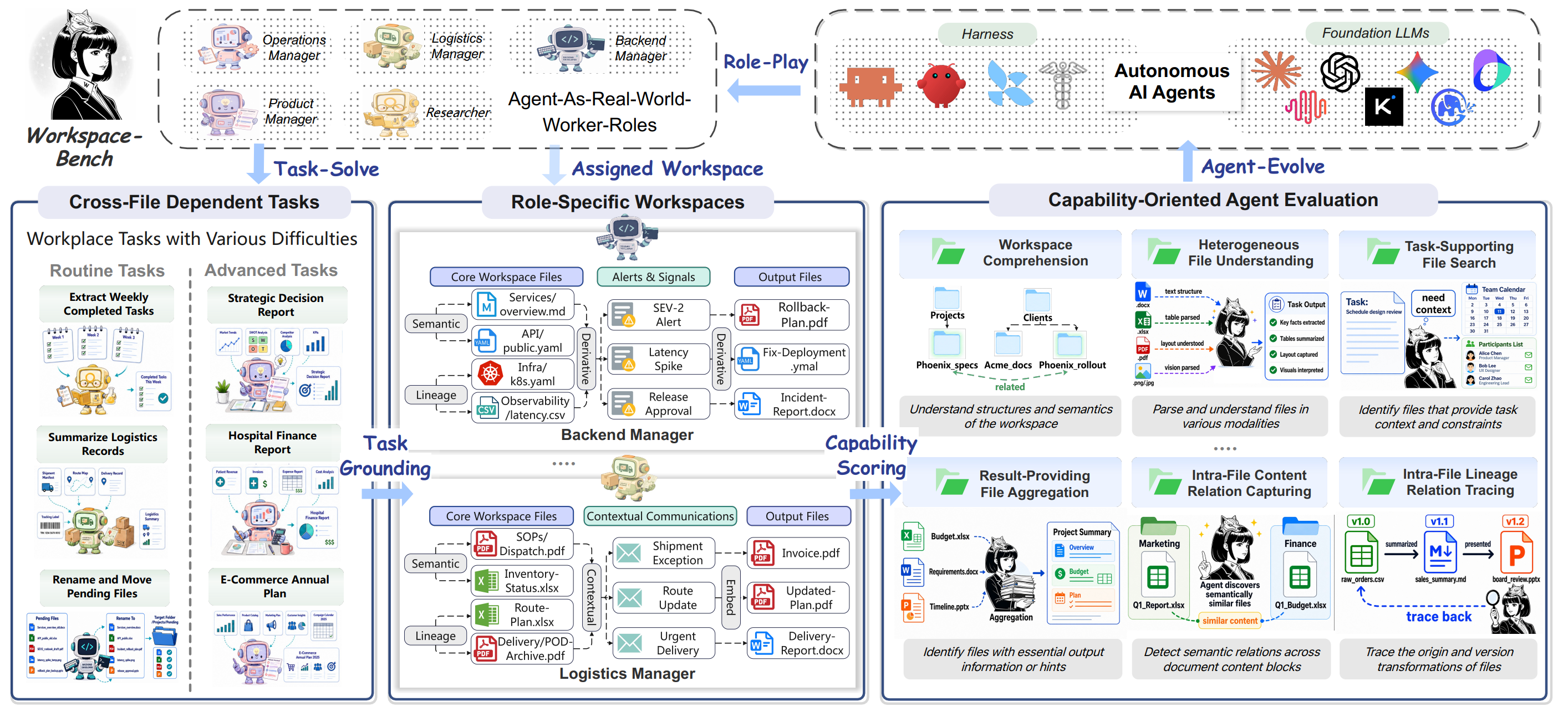
The official Workspace-Bench framework figure summarizes how role-specific workspaces, benchmark tasks, agent execution, and capability-oriented evaluation fit together.
What Workspace-Bench Measures
The benchmark focuses on workspace learning: the ability to identify explicit and implicit file dependencies, integrate context across artifacts, choose the right actions, and produce dependable deliverables in large workspaces.
Workspace Exploration
Navigating deeply nested directory structures and identifying relevant files from noisy candidates.
Task-Supporting Files Utilization
Finding files that provide essential context, references, and domain knowledge needed to complete a task.
Result-Providing Files Utilization
Aggregating result files that contain required outputs, formats, and baseline information.
Content Relations Understanding
Tracing explicit references, semantic connections, and contextual links between related documents.
Semantic Heterogeneous File Understanding
Connecting information across diverse modalities including documents, spreadsheets, presentations, and code.
Lineage Tracing
Understanding file versions, revisions, and derivation relationships (e.g., report_v1, report_final).
Current Performance Gap
Workspace-Bench exposes a large gap between human performance and the best AI agents. The gap grows in profiles with more hidden dependencies, denser file graphs, and stricter rubric requirements.
Resources
Use the benchmark website as a compact index to the paper, repository, dataset composition, and submission process.
Leaderboard
Browse official scores, cost comparisons, and capability views.
Dataset Visualizations
Inspect task composition, file types, workspace sizes, and profile distributions.
Methodology
Read the workspace learning definition, scoring rules, and reproducibility protocol.
Representative Tasks
See concrete examples of hidden dependencies and rubric-based grading.